



On 17 April 1527 the most extraordinary events unfolded at York Place, Wolsey’s palace in Westminster.1 Henry stood on trial, presided over by Cardinal Wolsey, who as Cardinal a latere was the Pope’s representative in England, as well as Bishop Warham, the Archbishop of Canterbury. The king stood accused of having lived an adulterous union with his brother’s widow.2 Henry is the defendant, answering the charges, although, he is not in a subordinate position, but rather next to Wolsey, who had to ask the King’s permission to begin. Henry graciously grants it, then after reviewing the facts of the marriage, appoints a counsel and departs. Wolsey appoints the promotor of the case (i.e. an inquisitor), Dr. Richard Wolman. Wolman’s job as promotor was to build the case against Julius II’s bull of dispensation.
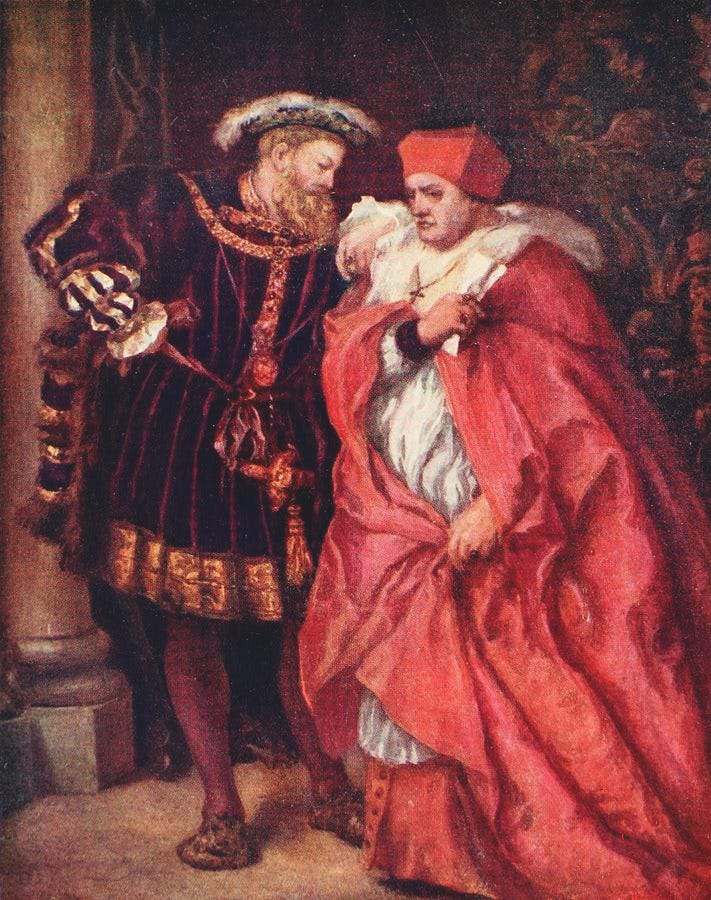
The whole thing was a carefully crafted mock trial, with very real consequences. Wosley and Warham were guiding Henry’s case through a canonical process, while at the same time, Henry would appear not to have initiated the process. Then, when Wolsey would pronounce in Henry’s favor (the inevitable conclusion), he would go to Katherine, heart-broken to inform her that he’s sorry, but must obey the Church: and just must marry this other woman. Katherine was not called before the trial, was not invited to give her side, and if the plan had gone right, Katherine would not have found out until it was too late for her to do anything.
After Wolman had finished his work, he had highlighted a number of weaknesses in the Bull, and also compiled several arguments from Scripture, including the verse in Leviticus 18, forbidding a man from marrying his brother’s widow. During the process of the trial, Wolsey made a journey to Rochester to see the most celebrated theologian in Europe, who was one of the select theologians proposed to sit on a council of experts to lend support to Henry’s case. But if Wolsey had hoped Fisher would make his job easier, he was sorely mistaken. When looking over the scriptural arguments, he noted that the verse in Leviticus is often combined with a verse in Deuteronomy, exhorting a man to marry his brother’s widow to raise up children for his brother, and Fisher came out very strongly in favor of this position. Moreover, when examining arguments made from divine law, Fisher said, “I think I see it easy to unravel all the arguments which they produce who deny it to be lawful by the divine law, but not so easy to answer the others; so I am fully persuaded that it cannot be proved by any solid reason that it is prohibited by the divine law now in force that the brother of a brother deceased without children shall take his wife.”3 Moreover, he came to the same conclusion as Cajetan, that the fact that the Pope had done it was a sufficient enough sign that it could in fact be done. This was troubling to Wolsey, and he forwarded the opinion to Henry on 2 June, accompanied by a cover-letter where he attempts to soften the blow of Fisher’s opinion. Just the same, one of the weightiest of experts was not on Henry’s side.
Then something else happened. Wolsey had created this mock trial, but had not pronounced the result according to plan. Rather, at the eleventh hour, he announced that it was too difficult a case, and it was going to be forwarded to a panel of theologians; the York Place tribunal would never sit again. Wolsey, as the Pope’s representative in England, could have in fact made the decision, and as we shall see the Pope would not have over-ruled him. Did Wolsey have a sudden attack of morality, or was he playing at something else? It seems that for once, Wolsey actually told the truth. Fisher’s testimony either rattled him, or confirmed doubts he already had, and he indeed found the case difficult. Ultimately it would have to go to the Pope, but, as Wolsey discovered, the Pope was no longer in a position to listen to Henry’s suit; Rome had been sacked by Charles V’s mutinous troops, and was a de facto prisoner in the Castel Sant’Angelo. Charles had of course condemned his soldiers’ actions, but one never lets a crisis go to waste. The Pope was in his control, and as Henry needed no reminding, he was Katherine’s nephew.

Continue Reading at Pelican Plus.
Pope Clement VII
The Pope to whom Wolsey had hoped to petition in the King’s Great matter was Giulio d’ Medici, the younger cousin of Pope Leo X. Though he had been eager for Church reform, as Pope Clement VII he had settled into the familiar habits of a renaissance prince. Clement had a reputation as a competent administrator and a hard worker, but as Pope avoided making decisions. Fr. Philip Hughes says, summarizing the views of ambassadors and others who dealt with him: “First an utter inability to give a firm decision .... Then, an inability so to speak as to carry the conviction with men of experience that he spoke truly.”4 In a word, he knew how to say, rather splendidly in Italian and Latin, every word but yes or no.
