


It was fitting that three of the continent’s foremost intellectuals, activists, and writers should meet in Austria’s capital to discuss Europe’s endangered future and policy solutions which may determine its fate. It’s no exaggeration to recall that this city has on more than one pivotal occasion been brought to the crossroads of history and is no stranger to the birth of great and terrible ideas.
Inside an old Viennese home, by the flicker of candlelight and under vaulted ceilings – an enchanted ambient setting replete with antique furniture, Santiago crosses, and memorabilia of the Holy Roman Reich – three men, all of whom profess to be Catholic, attempted to diagnose the spiritual and philosophical malaise behind Europe’s trajectory to suicide.
Their wisdom and ideas were necessarily edifying and rousing at what, as the Europhile but African-born Cardinal Robert Sarah describes, is an hour in the day already “far spent.” Despite being the Center of Europe in more ways than one, Schoolchildren in this host city are already over 40% Muslim, and there is a mutually held concern about the conflict that may bring in the future. With a sense of urgency effectively communicated, the speakers’ words inspired fervent discussions which continued among the politically active guests long into the early morning, with a clear and hopeful atmospheric buzz over cigarettes and cigars and glasses of Grüner Veltliner. These are the atmospheres in which movements crystallize.
Yet curiously, and perhaps until now uniquely, Catholicism and the Christian faith more broadly held a strangely central place in the discussion, as did its prospective role to play in the future. Moderated by Harrison Pitt, an articulate and gentlemanly young Englishman and leading policy fellow at Restore Britain, who was a frequent and welcome participant in the discussions, the featured speakers were Renaud Camus and Martin Sellner.
Mr. Camus is a senior philosopher and writer known for coining and popularizing the term “Great Replacement” (something which delightfully appears to give liberal technocrats sleepless nights). In 2025, he was denied entry to the United Kingdom because his “presence in the UK is not conducive to the public good.” This was despite the fact that he enjoyed prestigious institutional patronage and was due to speak at the Oxford Union the following month. His ideas have been a pivotal influence on French presidential candidate and prominent politician Éric Zemmour.
By contrast, Mr. Sellner is a 37-year-old, masculine, sturdily built, and sleek-looking author and political activist. He is also a heavyweight on the European right and is the founder of the influential “Generation Identity” movement, something which has become a blueprint for young nationalist movements across the continent. Sellner was similarly granted the honor of having been denied entry to, and deported from, the United Kingdom by the overseers of our suicidally empathetic state.
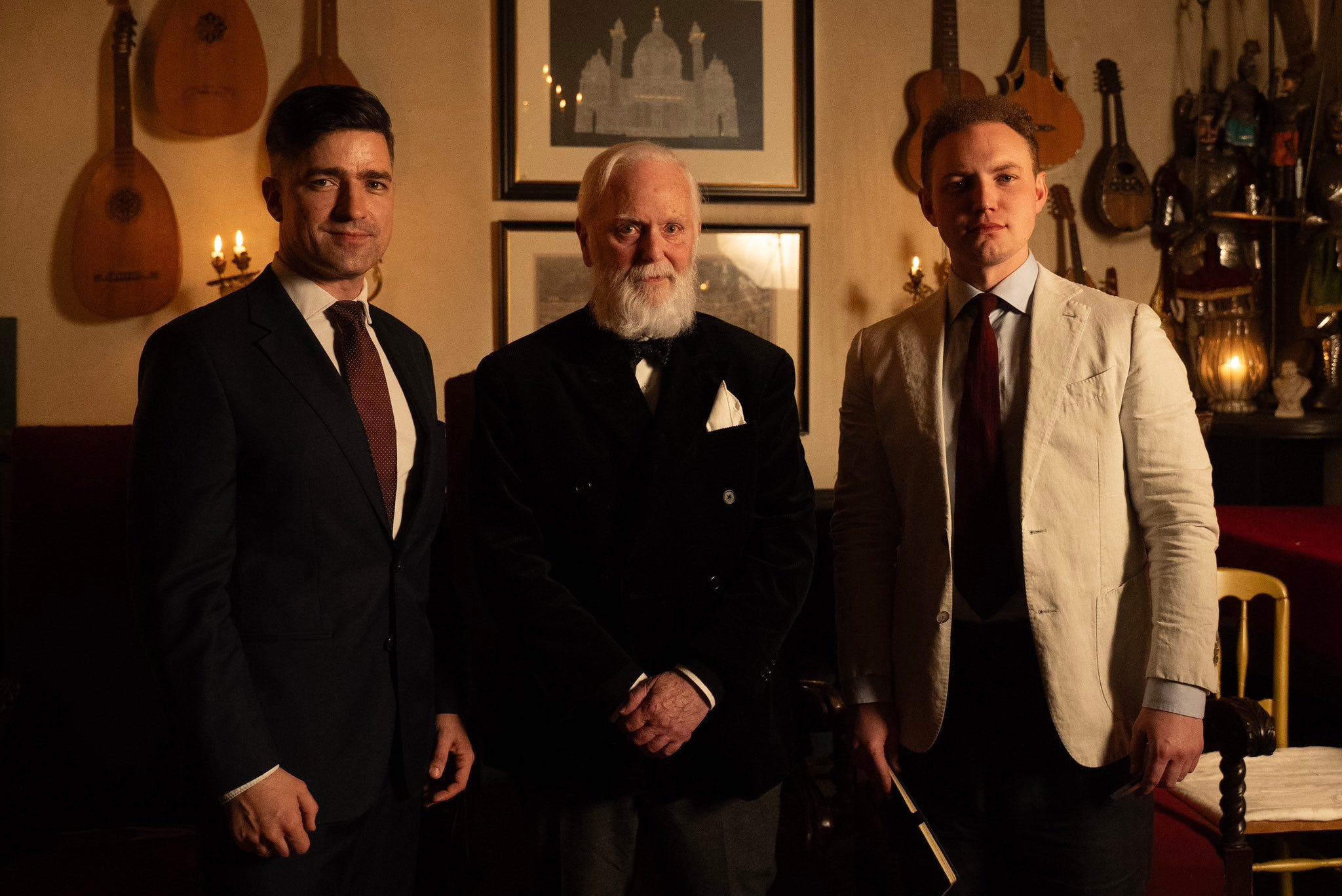
Their talk is available on YouTube. I urge all to watch it and pay attention. Something tectonic is happening. A new intellectual right is forming. It is reassessing commitments to liberal philosophical premises that have led us here. The talk served as an epicenter for a growing number of serious political discussions surrounding issues – the “Great Replacement” and “remigration” – which are likely destined to be the defining ones of our era. It is worthy to watch for that reason alone, but it is particularly relevant for Catholics because something contemplated (a primary reason for my attendance and professional interest) was the extent to which this is our fight as Christians. Also considered was whether our religion may hinder, help, permit, or inspire the resistance.
For esteemed company so controversial and indicted, a more naïve and unfamiliar observer might assume the conversations would take a vituperative and hateful, reactionary fervor, identifying positions only in relation to what, and whom, we are against and dislike.
Not a bit of it. Despite whatever calumnies may be thrown around by their enemies, I would exhort readers to listen to these speakers and see for themselves. The talks which proceeded that evening from symbolically finely carved and upholstered chairs were evidently and visibly animated by a spirit that has followed Camus, Sellner, Pitt, and their compatriots all of their careers: love. Love for one’s country and civilization, and a desire to see it preserved, saved from irreparable harm.
Camus lamented recent history in Europe, including the atrocities of the 20th century, as “so tragic and dramatic.” He suggested that the lingering shadow of the Second World War was the basis of a severe “self-examination,” something he feels is particular to European man – potentially inspired by his religious tradition of confession and penance. Yet this characteristic, he believed, turned into a sort of self-cannibalization. Sellner concurred and diagnosed that “we are killing ourselves… the basis of the Great Replacement is ethnomasochism.”
Sellner too traced this new phenomenon to its religious background, but reflected that “the European people… when they’ve lost the higher transcendental cause, apparently they cannot live anymore.” He singled out the dominance in this vacuum of an “ideology of relativism [and] self-hatred.”
Sellner suggested the malaise is fixable, and that good news lies in the fact “Europe is not dying of old age.” He believes that if groups who promote this murderous ideology for profit are countered, crisis may be averted. Framing this spiritually, he added, “to start remigration, we need to learn to love life again,” adding, “we need to learn to love and respect and accept ourselves again.”
Both Sellner and Camus rejected the notion that the source of Europe’s propensity to surrender itself to hostile outsiders and strangers is inherently predicated on slavery or historical crimes, which other civilizations such as the Chinese and Arabic (with the Barbary slave trade) have been equally guilty of. Sellner believes there is instead a “metaphysical” cause: a nefarious new “civic religion.”
Sellner is on to something here. He continued to explain that the suicidal religion “borrows a lot from Christianity; there is a lot of confession and penance – but there is no forgiveness.” This is a point historian Tom Holland has advanced. A new humanitarian heresy of the Christian faith, simultaneously shaped by the Beatles and cultural currents of the 1960s alongside the nouvelle théologiens of Vatican II who overemphasized the role of kenosis (Christ’s selfless emptying out), advocates that only in a kind of suicide is redemption found.
Such heresiarchs also frequently talk as if only people with white skin are capable of cruelty, barbarity, and sin – almost resurrecting a kind of Manichean dualism between the sick and decadent European Christian West and the pure and poor third world. In British law, hate crimes are only impossible against whites and Christians. Importantly, Christ Himself strongly condemned such thinking, reminding us that although less may be expected of him, even the poor man who was handed one talent in life is expected to yield back good fruit, and that even his meager wealth shall be taken from him and given to those who prospered better should the poor man fail to live righteously. This destitute but fruitless soul will be cast out into outer darkness, we are told. Yes, in the authentic Christian religion, there is no naïveté about the fact that the poor and downtrodden can be culpably wicked too.
Sellner suggested Europe’s descent into suicide is a result of its sociologically determinist thinking, where all the evils of the world are often presented as the fault of the “white man,” if not by direct causation, because he didn’t use his wealth and privilege enough to help others. He explained, “if criminals rape people, it’s also our fault… but actually [here] is a hidden, supremacist ideology, because it takes away agency from these people.” This, I find, is a pertinent observation. If we can recognize the capacity for cruelty, theft, and domination in our own people, why is this capacity so often denied to other races, religions, and nationalities? To do so is to deny their humanity.
Taking place with the backdrop of the beautiful surroundings of the storied city of Vienna, there was a palpable sense of both optimism and exasperation in the room. These were thinkers tangibly struggling to help rescue the soul of a continent, one whose heritage the participants instinctively recognized as worthy and good. Sellner lamented that Germans are “not allowed to feel pride about Mozart, Goethe, or Schiller,” as Camus rejected the exclusion from Europe’s “corpus” by the presently dominant petit-bourgeois of the likes of “Beethoven, Wagner… high literature, high music, high culture, high architecture.”
The speakers mourned that the transmission of these good and beautiful (indeed, Christians may legitimately feel them transfigured and blessed) things was being denied to new generations. Their words revealed a conviction that cultural self-destruction was neither a kindness to new generations of Europeans nor to new arrivals themselves. After all, where is the sanity in carelessly discarding such treasures? “Do not throw your pearls before swine,” counsels the Holy Ghost. Is it sane to transmit such a precious inheritance to people who often have little regard (if not active disdain) for it? “It is not right to give the food of the children to the dogs,” warned Our Lord.
Indeed, perhaps the most important moment came when Pitt directed the discussions to something which has been the topic of my work and focus, forcing a direct confrontation. “There is debate on the European right at the moment,” Pitt explained, “about the extent to which Christianity is an obstacle to rediscovering a sense of self-interest… [or whether] Christianity is core to Western civilization and there can be no possible restoration… without a renaissance of Christian belief.”
Mr. Camus revealed that though he considers himself historically Catholic, he finds that he is today nevertheless “less and less Catholic” as the Church abandons its traditions and folk. Though in traditional circles, a sophisticated, virtuous, patriotic, and intellectually formidable remnant of the Catholic world is very much alive and thriving, I unfortunately cannot argue that he is wrong. The hierarchy and landscape, for now, while they still reel and slowly recover from the wreckage caused by the malignant “spirit of Vatican II” and the liberalism it introduced, are not the unequivocally healthy, sane, divine, and enlightening things they ought to be.
Sellner did, however, point out that self-hatred and replacement appear to be inversely correlated with serious observant belief, giving the example of Poland – which is simultaneously the most religious nation in Europe and one of the most patriotic.
Sellner professed his Catholic faith more confidently and openly than his counterpart and was resolute in explaining that though a perverted form of the Christian faith was behind the weakness, it was not the authentic thing. He quoted Carl Schmitt, who argued that “if you look at medieval Christian Europe… Christians believed in loving your enemy, but nobody thought that meant that the consequence of this would be to deliver Europe to Islam.” Quite. Queen Isabella the Catholic of Spain, moreover, was perhaps the world’s first patron of remigration. The fierce piety of the Catholic past should reassure patriotically minded citizens that the Church and her faith are no mere source of death and surrender.
Yet I still couldn’t help feeling frustrated, as here were two men (and indeed an entire room representing a nascent movement) ready to welcome and embrace and recognize the truth and beauty of a strong and civilizationally muscular Catholicism and Christianity – one that loves and defends her children like a loving parent. Yet some representatives of the Church hinder countless souls in a similar mindset, for they are not alone, because these representatives and clerics do not appear to fight for them. Who can blame their hesitation? These patriotic and inquiring minds merely recognize a simple common-sense truth: that suicide – either individual or continental – is wrong.
The tragedy is that the authentic Church believes this too, and even under Popes Francis and Leo XIV its doctrine that, as the present pontiff said, “every country has a right to determine who and how and when people enter” – and that it does not advocate “open borders” – has been preserved and restated. Yet for outsiders, such sanity is all too often unclear, drowned out by a cacophony of uncareful and uncautious rhetoric about “welcoming the stranger.” If we wish to reassure souls otherwise potentially sympathetic about our Church and religion, orthodox believers will need to do a better job at voicing the other (silenced) side of the equation regarding migration. After all, it will always be significant that Christ commands we love others as ourselves, not instead of ourselves.
The evening’s event was organized by the European Conservative, whose editors Ellen and Alvino-Mario Fantini are both also observant Catholics. They did so in cooperation with Vauban Books, a publisher committed to translating dissident materials into English. Indeed, I was invited in my capacity as a Catholic journalist after establishing a friendship and contact with the people at Vauban while I was reviewing their latest publication of The Camp of the Saints, a rousing civilizational (and similarly radical and forbidden) work by traditionalist Catholic author Jean Raspail.
All of which is to point out that while the questions of Europe’s demographic and civilizational future are independent of and distinct from the Christian faith, the matter, as the personnel (and decoration) in the room revealed, is not unrelated. There is a crucial overlap anyone honest can’t ignore.
Hilaire Belloc, in his seminal work of Catholic historiography Europe and the Faith, famously traced how and why he argued “Europe is the Faith and the Faith is Europe.”
And Belloc is right. If Europe is beautiful and great (and the sheer architectural elegance of Vienna, with its great musical and culinary legacy, amorously and open-handedly calls to any visitor that she is), much of the reason for that is thanks to her necessarily Hellenized and Latinized Christian faith – her foundation. The Christian faith, born in the Near East and spread first to Africa, may be conceptually independent from Europe and her heritage, but it is historically inseparably interwoven into Europe’s story, soil, and soul. Through Greek reason and Roman governance, Europe became the Christian faith’s home and base. It is where the mustard seed put down its roots, to flower and send out branches to the far corners of the world.
The Church may survive if Europe is submerged by Islamic or otherwise religiously alien migration, but only as a husk of its former self, severely dismembered and impoverished – two thousand years of its substance hacked away.
And so while Rusty Reno may carefully and largely reasonably argue in First Things that Christ didn’t die to save Europe, I still disagree. He did die to save, and indeed bless and transfigure, Europe, even if that isn’t the only reason He died. He died to reconcile sinners to Himself and pour graces upon those who unite themselves with Him. And one continent above all, however imperfectly, attempted to do so in history. He made His dwelling in us and we in Him.
Additionally, even if they are instinctively wary of right-wing politics, today Christians simply must force themselves to reflect: how many cathedrals (like the great Notre Dame) may go up in flames if remigration or a politics interested in civilizational continuity aren’t pursued? The Observatory on Intolerance and Discrimination Against Christians, which Mrs. Fantini used to lead, assiduously documents the surge in anti-Christian crimes countries on the front lines of mass migration are witnessing. Some of these, disturbingly, go far beyond mere vandalism and violence. Tabernacles have been assaulted with axes, and excrement has been smeared on consecrated hosts.
On top of this, how many monasteries may be forced to close? When Fr. Marcel Lefebvre was a missionary with the Holy Ghost Fathers in Senegal and was producing droves of converts, he credited his spiritual successes to the prayers and devotions of the little Carmelite nuns who were present in Dakar. How much worse might things get without such spiritual merits and petitions on a continental scale?
Meanwhile, how many relics may be lost, destroyed, or desecrated? With the fire at Notre Dame, the Crown of Thorns was nearly reduced to ash. When Danes sacked Lindisfarne and the Muslim Caliphate conquered Jerusalem, it was the instinct of the Christians of old to protect and preserve such incomparably spiritually powerful treasures. The body of St. Cuthbert was transported for years until it landed in Durham. The Sudarium of Oviedo, a facecloth at Christ’s Passion, was evacuated all the way to the other side of the world in Spain – only for Muslims to follow and nearly capture it.
How many artworks – Caravaggios, Botticellis, Rembrandts – so sublime they have converted souls and fortified many more may sink with the ship if Europe is filled with folk who have disdain for her past?
Sellner posted a video on X shortly after the talk that he “would be willing to fight and die, just to preserve this small unexpected chapel in Vienna.” Camus also shared an image of a recently defaced church in Bordeaux plastered with the graffiti “Kill all the white men.”
Living the Christian faith virtuously and the fight for European cultural and demographic continuity might be conceptually distinct – but in our embodied, incarnational, historical world, in reality it is one and the same. We largely live and die together. And as migration continues, we are witnessing attacks on churches, and indeed synagogues, rise exponentially.
Vengeance may be for God alone, says Scripture, but justice isn’t. And the just man defends the innocent, and what is holy.
As the Book of Maccabees cries: “Let us rise up… and let us fight for our people and our sanctuary.”
“I think we can only survive if we drive the people who belong to this crazy cult out of the institutions of power – of media, of the Church, and of politics,” stated Sellner. I agree. This is my humble constituency as a Catholic journalist. I intend to write a book diagnosing and condemning this heresy of civilizational suicide and discontinuity. If we wish to save both the Church and the continent in which it made its home, this is our fight.
For my part, I believe the Christian faith on separate apologetic and historical grounds than its cultural relevance and beauty, or because it may provide a basis for right-wing politics and civilizational self-defense. But the fact it brings with it all of the above hardly hinders my ability to see the truth in it.
The Book of Ecclesiastes informs us there is a time for war and a time for peace. Far from pacifistic, Christ, who brought the sword, praised the centurion, a violent agent of the state, as possessing “greater faith” than any in Israel. When remigration may be the only way to prevent avoidable evils and horrors down the line from afflicting an entire continent, will we find the fortitude to cast out paralyzing pity and do what is necessary?
As candles burned low and we stepped out into a private courtyard reassuringly surrounded by greenery, fountains, and statues of the Blessed Virgin, it seemed that a contingent just might.
We are in a moment. And what is emerging is a political right soul-searching seriously about our religion’s civilizational, ideational, and philosophical merit.
Will Catholics be part of this movement, aid it, and help its proponents in defense of their Christian and civilizational heritage? Will the ghost of quasi-Christian, suicidally empathetic humanitarianism be exorcised? This remains to be seen. But if so, that Viennese evening may have helped topple a first and very crucial domino in the way.